
Head of Family Law, Jane McDonagh, has been quoted in the FT
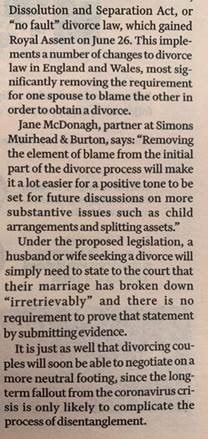 Partner Jane McDonagh has been prolific in the press lately, lending her expert knowledge to topic of the ‘no-fault’ divorce bill. The latest piece to have quoted Jane is entitled “How to get divorced – and keep your fair share of the assets”, which has been featured in the “FT Money” section of last week’s Financial Times. The full article can be found here.
With the increase of divorce inquiries due to lock-down, the article discusses the strains that have been placed on even the strongest relationships, and how the currently volatile economy will impact on the ability for couples to divorce.
Amongst the many problems faced going forward, the passing of the Divorce, Dissolution and Separation Act provides some hope. As Jane McDonagh has said:
“Removing the element of blame from the initial part of the divorce process will make it a lot easier for a positive tone to be set for future discussions on more substantive issues such as child arrangements and splitting assets”.
Jane has previously written a thought leadership piece for the FT Adviser discussing this topic in full, entitled “What the ‘no-fault’ divorce bill entails”, which can be read here.

If you would like any advice on this matter, please do not hesitate to get in contact with Jane McDonagh or any of our Family Law team.
Other News
-
21st January 2021 Dispute Resolution, Media & Communications Disputes
All in on blackjack.com pays off with big win
In a judgment handed down on Tuesday 19th January, SMB won a claim to recover the domain name blackjack.com on behalf of our client, Hanger Holdings.
Read more -
25th April 2024 Corporate, Commercial & Finance
Two members of SMB’s Corporate department complete London Marathon for charitable causes
We are delighted to announce that Corporate partner, David Martin, and associate Tim Graham completed the London Marathon last week, raising money for two charitable causes.
Read more -
2nd February 2021 Media
SMB advises on the production and financing of new film “Save The Cinema” for Sky Cinema starring Samantha Morton, Tom Felton and Jonathan Pryce
SMB’s Media Team have advised FAE Film and Television Limited on the production and financing of new film Save The Cinema for Sky Cinema.
Read more